|
Author
|
Topic: C15th Tentage
|
Dave Key
Member
Member # 17
|
 posted 09-06-2000 04:46 AM
    
Comments on both the Companie of Saynte George and Red Company's list has prompted me to ask what evidence (rather than opinions) people here have for the use and construction of c15th tentage.
In essence I'm thinking of construction materials (fabrics etc.), decoration (paints? dyes? embroidery?, waterproofing? etc.), construction techniques.
However I'm also curious about how far people feel there should be tentage at all.To start the ball rolling here's a quotation from the Issues of the Exchequer ... Issue Roll, Easter, 4 Henry V
July 29th, To our Lord the King, in his chamber. In money paid into the same chamber by he hands of John Broune and John Burnham, for cost incurred for the carriage of tents, ornamented with gold and cloth of arras, with hangings and sides of arras, and other appurtenances whatsoever, for our said Lord the King and the Emperor to dwell in at Calais, during the time of their stay there, - 20l. [20 pounds sterling] Cheers
Dave
Registered: May 2000 | IP: Logged
|
|
Fire Stryker
Admin & Advocatus Diaboli
Member # 2
|
 posted 09-06-2000 07:10 AM
Looking through Die Burgunderbeute on page 365 and being that I don't speak or read German/Swiss it seems that they talk about the booty taken from Grandson and list off the collection in French. quote:
...die im Lager Karls vor Grandson standen, Wir wissen, dass sich der Herzog nach La Riviere, Ende Januar 1476, Zelte herbeischaffen liess: 600 petites tentes et pavillons, 100 autres pavillions quarrez, deux maisons de bois, 130 tentelletes quarrees et 50 autres pavillions, 6 grandes tentes et 6 grandes pavillions quarrez et une autre maison de bois pour servir en son armee.
Looks like a WHOLE bunch of tents, pavillions, and a couple of portable wooden houses were taken at Grandson. So there seems to be an variety of "types". I also read somewhere that Charles had a list requesting tentage. I am currently looking for this source. We also have a book that should be arriving soon "The army of Burgundy 1465-1468" If there are any references to such things we will be sure to post them. It is in French so it may take us a little while to translate it.  Other evidence is contemporary drawings. The tents that follow are clearly Burgundian by their livery markings and heraldry. These tents show some designs that appeared on them. I do not know if they were painted or embroidered and will not venture a guess as we are looking for evidence and not opinion. 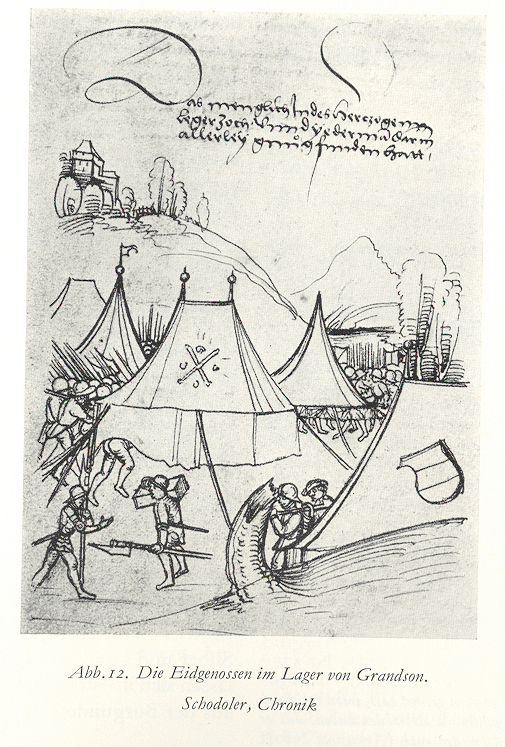
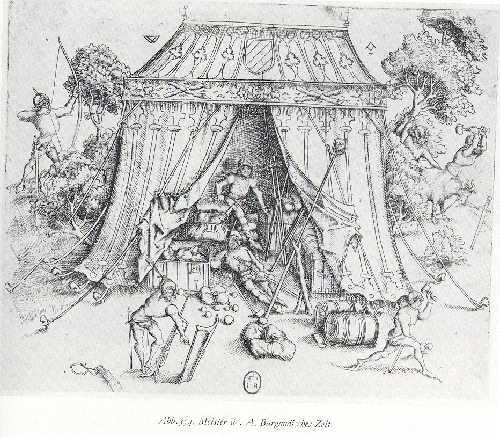
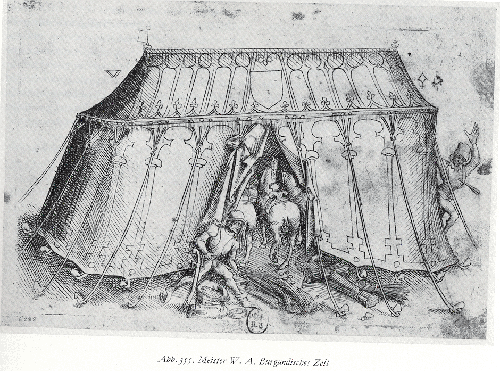 The first image shows a camp with a town or castle on the hill in the background. The next tent appears to be a storage tent. The last tent appears to be a "stable tent". Several saddled horses are clearly seen inside. Hope this is of use. Jenn R.
[edited to update links] [ 05-20-2003: Message edited by: Fire Stryker ] -------------------- ad finem fidelis
Registered: May 2000 | IP: Logged
|
|
hauptfrau
New Member
Member # 0
|
posted 09-06-2000 03:19 PM
Alta Vista gave me this translation:600 small tents and houses, 100 other pavillions {will quarrez}, two wood houses, 130 {tentelletes quarrees} and 50 other pavillions, 6 large tents and 6 large pavillions {will quarrez} and another wood house to be useful in its army. {will quarrez} is obviously a translation glitch but may be an obscure adjective describing the type of tent. We need the root of "quarrez" to know for sure. In any case we're talking an IMMENSE amount of housing. What are the supposed numbers for the army using those tents and houses? Gwen
Registered: A Long Time Ago! | IP: Logged
|
|
|
|
chef de chambre
Admin & Advocatus Diaboli
Member # 4
|
posted 09-07-2000 05:33 AM
Hi All,A couple of things to keep in mind. First, there is never one person to a tent. I suspect the smaller Burgundian tents were on the order of bell wedges, and housed near half a lance. Most armies reckon on a certain percentage of soldiers being on guard duty at any given time, and that is a normal part of the equation when supplying tentage. The grand pavillion of Charles - to my recollection from first hand descriptions (De la Marche & a couple of others)consisted of near 20 large tents of varying descriptions put together making up aisles, halls, and a chapel (said to resemble a castle). It would have housed Charles, his servants, and a large percentage of his bodyguard. Servants probably slept in aisles connecting pavillions, between tent 'layers' (many of the grand tents had two layers of wall apparently), and in general wherever they could find a sheltered horizontal surface. Grandson had been a succesfull siege for the Burgundians before the battle, and no doubt a significant percentage of troops were still bilited in any standing structures close by (as an example, de La Marche had been billited with a number of soldiers in a monestary near to the siege lines at Neusse in 1475 - and there is documentation for a huge number of Burgundian tentage - I will post later when I have a spare moment).. The castle had just recieved a Burgundian garrison as well, and the majority of the household troops (there were near 2000 of them at Grandson)had been moved to a forward position several miles from the battlefield and to the right of the army into a semi - ruinous castle (who's name escapes me) to act as a fortified strongpoint and forward position in the assumed path of advance of any Siss relieving force (so that while they were heavily engaged with Swiss foragers (near half the army) and bloodied their noses, they took no part in the actual course of the battle - as the Swiss came upon the Burgundian army from an unexpected point.) Sorry for the brevity, but I must run to work.  ------------------
Bob R.
Registered: May 2000 | IP: Logged
|
|
hauptfrau
New Member
Member # 0
|
posted 09-07-2000 12:45 PM
Bob- I think you need to check the definition of "brevity" before you use it again. Quoting "The Princess Bride" - 'I do not think it means what you think it means..."  Anyway, the question was what evidence (rather than opinions) people here have for the use and construction of c15th tentage. Weren't some of the tents taken at Grandson preserved? I seem to recall one of them being displayed somewhere, but details are too indistinct to be useful. Jeff and Jamie went to see the "Land of the Winged Horsemen" exhibit at the San Diego Museum last year. It had all sorts of artifacts from late 16th thru 18th C. Poland including a tent. It was a rectangular marquis with painted (?) decoration, about 12' X 20', had toggle fasteners on the wall to the canopy, and a valance. It was also displayed inside out, with the toggles on the outside and the decoration and valance on the inside..... I'm also interested in these knock-down houses referenced-- were they made on site from available lumber, were they pre-fabbed and carted, who got to sleep in them,etc. I have a cool reference for painting tents and other articles but I cleverly left it home- I'll have to post it tomorrow. Gwen
Registered: A Long Time Ago! | IP: Logged
|
|
|
|
|
|
hauptmann
New Member
Member # 0
|
posted 09-07-2000 08:34 PM
My feeling is that the Burgundian "stable" tent is not where horses were "kept", but where they were tacked up. I know from personal experience that it's very helpful to have a place to keep your saddle and other tack out of the weather when on campaign, even better to be able to bring your horse to it for saddling. However, I think it's very unlikely that horses were "stabled" inside tents. Partly because of the need for tents to house MEN and valuable arms and armour, partly because horses can stand weather much better than men or gear, and also partly because horses like to move around a lot even when on a picket line and can destroy tents very easily. Only very large tents would hold enough horses to make them worthwhile and I believe it's more likely that if ANY horses were 'stabled' in tents, they were probably the prized chargers of the ultra upper echelons of the army. 99% of the horses would be outside picketed between trees for shade, or maybe under a 'knock down' wattle awning. Jeff
Registered: A Long Time Ago! | IP: Logged
|
|
|
|
Dave Key
Member
Member # 17
|
posted 09-08-2000 07:18 AM
The numbers for the Burgundian army have always fscinated me but I've been hard pressed to find anything to match in England. This is not to say that it isn't there but it just hasn't been published. However the following is the nearest to an explicit reference.. and here the scale is seriously less ...It comes from a 1475 Indenture to Richard Sturgeon to provide equipment for the Kings Ordnance to be taken to Calais (Ordnance includes but is not exclusively gunnery),
The inventory encompasses what we would call all war materials ... e.g. 1359 bows, 182 gross bowstrings and 10,360 sheafs of arrows ... but also armour, boats, assaulting ladders and ... Pavillions - 5 - each £6 10s - sum. £32 10s
Tent - 1 - each £7 15s - sum. £7 15s
Tent - 1 - each £13 10s - sum. £13 10s
Hall - 1 - each £7 10s - sum. £7 10s i.e. 8! (of which the Pavillions ae the cheap tentage!) I doubt whether this is just a supplementary number as the remanants of the equipment left in Calais were recorded and these include NO tents. This raises the question whether they were provided by individuals, or not at all. Certainly the use of billets rather than camps seems to have been the preferred option. But in an army prepared as well as Edward's for 1475 it is still surprising. Another possibility is that, if I remember correctly, this equipment was for the English soldiers going to support the Duke of Burgundy ... so maybe they expected billeting from him? Certainly the 1000+ bows would be in keeping with the scale of this force ... but in 1000 men you'd expect at least 40 Captains ... which would make 5 Captains per tent before you even start on the other men-at-arms, let alone the archers. Another black-hole in the English record strikes again Any thoughts Cheers
Dave
Registered: May 2000 | IP: Logged
|
|
hauptfrau
New Member
Member # 0
|
posted 09-08-2000 05:49 PM
Ok, here's some info on who did the decorating of tents:'In England, artists by and large enjoyed only lowly status. Only a handful of foreign artists working at the court ever achieved anything close to the position of some of their European counterparts. From 1502, registered painters in London were members of the Painter-Stainers Company, uniting the trade of painting on panel with that of the skill of making painted cloths for domestic wall-hangings. By the end of the century, panel painters were dominant, for the fashion for stained cloths had all but died out. When John Stow mentions the Painter-Stainers' Hall in his Survey of London, published in 1598, he notes that 'now workmanship of staining is departed out of use in England'. A proclamation of 1563 gives us some insight into the status of artists relative to other workers in terms of pay and conditions. Painter-stainers are recommended to receive £4 per year with meat and drink; this was less than carpenters, joiners and embroiderers (about £5 per year) and only half the remuneration of goldsmiths (£8). Painters at the Royal Court could earn far more, but even here the chance to specialise was often difficult to secure. The Florentine Pietro Torrigiano, who came to Henry VIII's court to make the tomb of the king's father, Henry Vll, for Westminster Abbey, specialised in sculpture in cast bronze and terracotta. Many other Italians in England, however, are recorded as working on a variety of tasks. The Florentine, Antonio Toto del Nunziata, was painting at Court by 1530 on an annual retainer of £25 and was granted denizenship in 1538. He indeed carried out 'dyvers tabulls' (tables, or pictures) of religious subjects for the King, but was also employed on heraldic painting for royal funerals and coronations as well as other temporary constructions for royal occasions. Girolamo da Treviso, who probably trained in Venice and had been a painter of altarpieces in Bologna, seems to have been employed by Henry VIII for his skills in composition; he was responsible for the small panel of The Four Evangelists stoning the Pope, now in the Royal Collection. He died however at the siege of Boulogne in 1544, probably serving as a military engineer. The Serjeant-Painters to Elizabeth l, like George Gower, painter of the most famous version of the 'Armada' portrait of the Queen, now at Woburn Abbey, spent some time on portraiture, but much more on supervising decorative painting, some of it restorations of earlier work, in the royal palaces. The appointment of John de Critz as joint Serjeant-Painter with Leonard Fryer in 1605 gives us a good insight into the duties expected for they are to paint, by James l's order ‘our ships and barges and "close barges", coaches, chariots, carriages, litters, wagons and "close carres", tents and pavilions, heralds' coats, banners, trumpet banners, also painting in connection with the solemnization of funerals in any way belonging'.
(From "The Tudor Image", Maurice Howard, Published by the Tate galleries to accompany the "Dynasties" exhibition. 1995 ISBN 1-85437-159-2) I included more background information about the role of painters in general (which I think fascinating) to lend context for the general discussion. I also know this particular reference is a bit late, but everything I've read about earlier painters from Vasari, etc. says just about the same thing. Hope this is helpful. Gwen
Registered: A Long Time Ago! | IP: Logged
|
|
|



 UBBFriend: Email this page to someone!

 posted 09-07-2000 07:54 PM


