|
Author
|
Topic: Brigandine Progress
|
chef de chambre
Admin & Advocatus Diaboli
Member # 4
|
 posted 06-02-2002 12:01 AM
    
Hi All,I've made some significant progress on the brigandine project that has been underway for the past year. I managed to nail in 75% of the plates that have been tinned thus far, and it is starting to resemble a brigandine rather than a funny looking velvet and hemp canvas pourpoint. It definately has a shape, and is not a straight-sided tube. And this prior to putting in the "V" waist plates. Some useful bits of information for those contemplating a similar project. As I've stated many times before, it is of the utmost importance to tailor the body of the garment well before planning out the pattern of plates. Although we were extremely careful with this part of the project, it seems there will be some excess of the foundation garment that must be retailored, else the plates will primarily be putting stess on the cover in certain locations. I have every confidence that we can do this with success, expending some effort to the task. Also, plan out and drill or punch holes where the strapping and buckles go prior to heat treating and tempering plates. We had only vaugly considered this, and as a result need to buy a new punch and drillbit. Take extreme care when nailing plates in to make sure the cover and foundation are smoothly over the plate prior to working a nail through the cloth - we use a regular nail to work through the weave of the fabric so as not to damage the cloth, prior to prrning in an actual brigandine nail. We had little problem with errors of this sort, but I can see the potential for difficulties if extreme care is not taken. I will take some pictures and post them on this thread when I get the chance. -------------------- Bob R.
Registered: May 2000 | IP: Logged
|
|
David Meyer
Member
Member # 245
|
posted 06-02-2002 09:30 AM
Hi Chef -A quick query about your materials - Could you share your source of velvet and hemp canvas? I have brig plates (14th C.) waiting for their 1500 rivets to be installed this summer (!!), and I'm considering switching from a leather covering material to velvet, if a source of period material can be found. About the hemp - it makes sense to have a strong foundation fabric next to the plates. If memory serves, the 14th C. covered breastplate in the Bayerisches Museum in Munich (clearly not what you're working on, of course) is not covered with anything other than velvet. This leads me to think that either the velvet was VERY strong, or it was replaced frequently (or both). Any thoughts?
David
Registered: Nov 2001 | IP: Logged
|
|
chef de chambre
Admin & Advocatus Diaboli
Member # 4
|
posted 06-02-2002 07:05 PM
Hi David,There is no exact substitute for 15th century velvet. The closest thing is made in Italy, is intended for the high-end interior decorating market, and runs $1500 a yard, with the purchase of an entire bolt required. What I have used is real silk velvet as manufactured commonly in this day and age. It is upholstery weight velvet, the pile is silk (it was burn-tested to be certain), but the heavy backing is some man-made fabric. Even this runs $240 - $300 a yard. I bought the remainder of a bolt on the cheap - approximately 3 yards at $60 a yard. It is as good as I could do, and the synthetic backing is unnoticable as it is sewn to a hemp canvas foundation. Considering the construction, and the difficulties faced by those wh have tried to restore them, I sincerely doubt the velvet was replaced at all. It would be just as easy to make an entirely new brigandine as replace a cover on a completed example - and yet dozens of extant examples have come down to us more or less entire over a span of 500 years. The fabric has more endurance than you might give credence for. We chose hemp canvas as it is more resistant to moisture than linen canvas. Again, Armour is an expendable commodity that requires repair, and eventuial replacement. An upholstery weight cover sewn directly to a canvas liner is incredibly sturdy, I do not doubt my example will be structuraly sound for decades if properly cared for, although I must be carfeul with the effects on sunlight on the silk pile. You can pick up genuine heavy-weight silk velvet on e-bay, and at estate sales sometimes. As it was last manufactured in any quantity in the '30s, often what you get has degraded due to age. Hemp canvas is readuly available - Craig uses some online store that has been posted a doizen times - I don't have the site bookmarked as Craig is the fellow who buys it in bulk. Hope this helps. -------------------- Bob R.
Registered: May 2000 | IP: Logged
|
|
|
|
chef de chambre
Admin & Advocatus Diaboli
Member # 4
|
posted 06-02-2002 08:50 PM
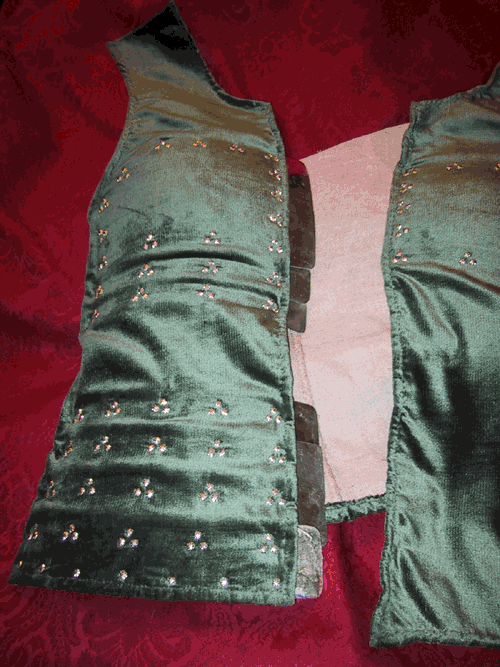
Hi All,Here are two pictures of progress. The first is the right front exterior
 Second is right front interior
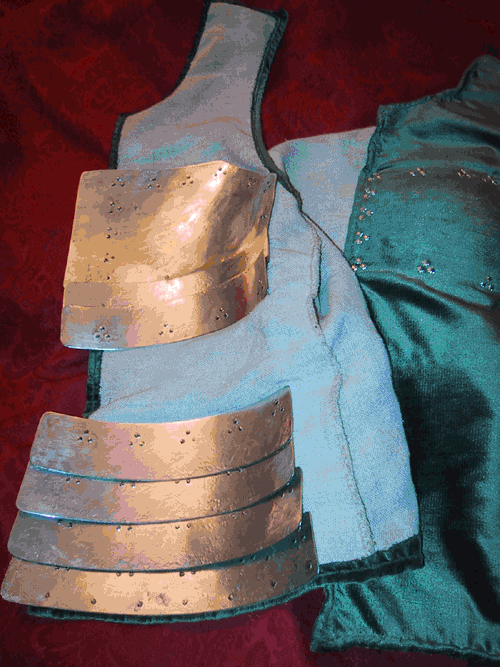 This represents about 6 hrs of work, placing the plates correctly and then peening the plethora of nails. The plates are high carbon steel, 20 guage for the smaller plates, with 18 guage lung plates, heat treated and tempered, and then dipped in pure tin for rustproofing. The nails used are the ones made from the castings of the extant 15th century brigandine nails from the Higgins Armory Museum's reserve collection - they have quite a collection of brigandine fragments. There are two normal plates missing between the waist and lungplates, as well as the waistplate (which is bent in a shallow V the curved), but the skirt is complete. I believe there are three sizable plates above the lungplate, and then a number of smaller plates onto the shoulder and around the aemhole and collar. [ 06-02-2002: Message edited by: chef de chambre ] -------------------- Bob R.
Registered: May 2000 | IP: Logged
|
|
|
|
chef de chambre
Admin & Advocatus Diaboli
Member # 4
|
posted 07-17-2002 08:45 AM
Hi Jim,I think this style of brigandine would work well for the portrayal. You might want to consider covering it with fustian if you can get it. I'll keep my eyes peeled for online pics of hangers and falchions for you. -------------------- Bob R.
Registered: May 2000 | IP: Logged
|
|
|
|
chef de chambre
Admin & Advocatus Diaboli
Member # 4
|
posted 09-16-2002 06:19 AM
Hi Ryan,At this point, *all* of the front and first row on each side is cut, sanded and filed, hardened and tempered and tinned, and will shortly be nailed in. When that is done the project will be 50% complete. Estimated finish date - Holidays 2002. As soon as I get more photos, I will post - more plates had been nailed in after these photos were taken. -------------------- Bob R.
Registered: May 2000 | IP: Logged
|
|
chef de chambre
Admin & Advocatus Diaboli
Member # 4
|
posted 09-23-2002 12:28 PM
Hi All,Latest news is all of the front plates save 3 small ones (and the waist plates which are the last plates nailed into the armour) are nailed in place, and the side rows are begun. -------------------- Bob R.
Registered: May 2000 | IP: Logged
|
|
|
|
chef de chambre
Admin & Advocatus Diaboli
Member # 4
|
posted 09-24-2002 10:06 PM
Hi Ryan,We commissioned custom nails from Guerney & Sons - a nail manufactuer here in Massachussetts in business since 1825. I don't have the address handy, but the item is officially known as "smooth shaft, grooved head Hungarian Nails" - they have the die, and can manufacture more, but I suspect they would want a large order. For complete authenticity they are tin plated - the whole deal cost us about $16 a pound, with about 3 pounds being the ammount for a normal 15th century bnrigandine. -------------------- Bob R.
Registered: May 2000 | IP: Logged
|
|
|
|
Ryan Ricks
New Member
Member # 275
|
posted 10-01-2002 10:36 PM
So you sewed the shoulders after putting the plates on?Looks awesome! I can't wait to start mine. Ryan P.S. How do you heat treat and tin your plates?
Registered: Jan 2002 | IP: Logged
|
|
chef de chambre
Admin & Advocatus Diaboli
Member # 4
|
posted 10-01-2002 11:17 PM
Hi Ryan,My brigandine straps together at the shoulders, the front overlapping the back a bit. As we have found out from experience, shoulders sewn together (as on the prototype brigandine, which is a copy of an extant example in Vienna) as if it were a doublet body is a weak point - the stitching is likely to come apart under the stress of having it laid out for any length of time. If the shoulders strasp together, the problem is avoided. Heat treating is done in an electric kiln, with an oil quench following an annealing. Tinning is by hand (wire, really) dipping into a specialy made tinning pot large enough to hold a breastplate half on a corrizone. Hope this helps. -------------------- Bob R.
Registered: May 2000 | IP: Logged
|
|
Craig Nadler
Member
Member # 7
|
posted 10-02-2002 12:33 AM
Chef:I quenched the plates in water not oil. Quenching Oil doesn't seem to harden 1050 carbon steel very much. -------------------- Craig Nadler
cwn@nh.ultranet.com http://www.nh.ultranet.com/~cwn/armour.shtml
Registered: May 2000 | IP: Logged
|
|
chef de chambre
Admin & Advocatus Diaboli
Member # 4
|
posted 10-02-2002 06:15 AM
Hi Craig,That is what you used on many of the plates of you prototype - nicht war? -------------------- Bob R.
Registered: May 2000 | IP: Logged
|
|
|
|
chef de chambre
Admin & Advocatus Diaboli
Member # 4
|
posted 10-02-2002 05:35 PM
Hi Erik, Well, I gots to measure you first, and keep in mind it took over a year to get these two to this point. I do reckon we could trade goodies at some point....
quote:
I must admit that it outshines what I do by a wide margin.
What? Are you nuts? I don't think so! -------------------- Bob R.
Registered: May 2000 | IP: Logged
|
|
|
|
Kalle
New Member
Member # 392
|
posted 12-03-2002 05:05 PM
quote:
Originally posted by Quartiermeister:
Hi There,I'm thinking about making a brigandine since some time now, but i cannot find a source for the rivets/nails here in Germany. Can anybody help me for a good suppliers adress?
Chef de Chambre: is there a URL for Guerney & Sons? I couldn't find them in the net.... Thanks a lot
Lutz
Hallo Lutz I am just curious, where is K-Town? I am from Cologne, Germany. If you are living near by, I would be interested in some brigandine nails. Maybe we can make a group order? Greetings Kalle
Registered: Dec 2002 | IP: Logged
|
|
|
|
chef de chambre
Admin & Advocatus Diaboli
Member # 4
|
posted 12-24-2002 07:01 AM
Hi All,We have begun patterning the rear plates. We got 16 patterned, cut out, sanded, filed, heat treated, and being tinned, as well as two missing side plates. Obviously we didn't meet the 'done by the holidays' goal, but this is the first time I had a chance to work on it since Deer season. -------------------- Bob R.
Registered: May 2000 | IP: Logged
|
|
Sebastian Kempkens
Member
Member # 264
|
posted 12-25-2002 10:17 AM
quote:
Originally posted by Kalle:
Hallo LutzI am just curious, where is K-Town? I am from Cologne, Germany. If you are living near by, I would be interested in some brigandine nails. Maybe we can make a group order? Greetings Kalle
Kalle, Lutz, I have 4 pounds of thjose nails left, make me an offer I cannot refuse  Sebastian
Registered: Jan 2002 | IP: Logged
|
|
hauptmann
unregistered
|
posted 12-25-2002 04:32 PM
Craig,Is this prototype of which Bob speaks the one you showed to me a couple Pennsics ago? The one with the bronze rivets? Some time ago, I suggested to Bob the idea of temporarily riveting groups of plates together for heat treating, so as to keep them from warping. Have you tried this? If so, how's it worked? Bob, If you say there are dozens of extant brigandines, can you say what the shell color range is? We know that red/rust/burgundy seems to be fairly common, but the only color other than that which I've seen seems to be black in Memling's Triptych of St. John the Baptist. What other colors have you seen in
a. extant examples
b. contemporary pictorial references (paintings, etc)
? What proportion of survivals have tinned plates? Having recently gotten into the spring steel stuff, we're finding the tempered finish might resist rust pretty well, so I wonder how necessary and common tinning is. The idea of tinning that many plates is not attractive to me. BTW, I'm gonna start making myself a brigandine soon, as are at least two others in the Red co., which is why I have these questions. I made a "fake" brigandine for the Cabrillo National Monument back in the summer, used the special nails, but the plates were aluminum. Overall, it looked very good, but now we want to build ones to use. Here's what the Cabrillo one looked like:

IP: Logged
|
|
|



 UBBFriend: Email this page to someone!
 posted 06-02-2002 08:23 PM


 posted 12-09-2002 11:50 AM


